• 70pc quota for govt, 30pc for private operators allocated in new Haj policy
• AI policy aims to train 1m professionals by 2030
• New building codes for all new structures with more than 4 floors; rainwater systems mandatory for residential, commercial & industrial structures
• Ex-mill sugar rate fixed at Rs165/kg, retail price at Rs173/kg

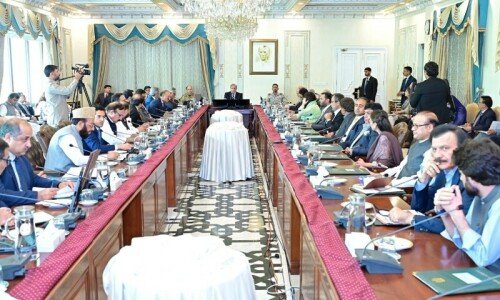
ISLAMABAD: The federal cabinet on Wednesday took several key decisions, including the approval of Haj Policy for 2026, National Artificial Intelligence (AI) Policy and the Green Building Code of Pakistan.
Meanwhile, Prime Minister Shehbaz Sharif fixed ex-mill rate and retail price of sugar at Rs165 and Rs173 per kilogram, respectively, amid the nationwide shortage of the commodity.
Presided over by PM Shehbaz, the cabinet approved the Haj Policy for the next year, allocating a 70 per cent quota to the government and 30pc to private operators. Notably, private companies that failed to fulfill their responsibilities in the previous year will now be required to accommodate affected individuals in 2026.
The meeting approved third-party validation for all Haj operations, real-time monitoring of payments and application processes under private operators, mandatory minimum of 2,000 pilgrims per private company, 1,000 seats reserved for hardship cases, enhanced digital tools including Pak Haj mobile app, digital wristbands, and mobile SIMs for better tracking and service delivery, transparent selection of assistants through competitive testing, emergency compensation mechanisms and upgraded lodging and food arrangements.
National AI Policy
In another major decision, the cabinet unanimously approved the National AI Policy 2025 to create a complete AI ecosystem in Pakistan.
The policy aims to democratise access to artificial intelligence, enhance public services, and open up new employment and innovation avenues.
“Our youth are Pakistan’s greatest asset. Providing them with education, skills, and equal opportunities in AI is a top priority,” said the prime minister.
The AI policy outlines to train 1 million AI professionals by 2030, establish an AI Innovation Fund and AI Venture Fund to boost private sector involvement, create 50,000 AI-driven civic projects and 1,000 local AI products in the next five years, distribute 3,000 annual AI scholarships.
Additionally, it aims to facilitate 1,000 research projects, promote inclusion of women and differently-abled individuals through accessible education and financing, strengthen cybersecurity and national data security protocols, promote global partnerships and compliance with international AI regulations.
However, an AI Council and a comprehensive Master Plan and Action Matrix will oversee the policy’s implementation.
The cabinet also ratified decisions made in earlier sessions of the Cabinet Committee on Privatisation and the Committee on Legislative Business, held on July 8, 17, and 25, respectively.
Building codes
The federal cabinet also approved the Green Building Code of Pakistan (GBCP) and the Rainwater Harvesting Provisions for Building Code of Pakistan.
These new national standards will ensure green, energy-efficient and water-conserving buildings.
The GBCP applies to all new buildings, with four plus floors, emphasising energy conservation, solar design, green roofs, energy efficient lighting, and integration of renewable energy sources etc.