President Donald Trump dramatically stepped up his rhetoric against Iran’s supreme leader on Tuesday amid the country’s ongoing fighting with Israel, saying on social media that the United States knows where Ayatollah Ali Khamenei is located but will not kill him “for now.”

The comments fuel questions as to whether Washington would join Israel’s attacks after insisting it had no hand in the campaign. Trump’s sometimes contradictory and cryptic messaging about the conflict has deepened the uncertainty surrounding the crisis. His public comments have ranged from military threats to diplomatic overtures, not uncommon for a president known for an often erratic approach to both domestic and foreign policy.
In another post, Trump also appeared to demand Iran’s “unconditional surrender!” as he fuelled questions about whether the US would join Israel’s attacks on Tehran’s leadership and nuclear facilities.
“We know exactly where the so-called ‘supreme leader’ is hiding. He is an easy target, but is safe there — We are not going to take him out (kill!), at least not for now,” Trump said on his Truth Social platform.
“But we don’t want missiles shot at civilians, or American soldiers. Our patience is wearing thin. Thank you for your attention to this matter!” said Trump.
Minutes later, the US president followed up with another message simply saying: “Unconditional surrender!”
Latest developments:
Trump ramps up rhetoric against Iran
Macron warns against regime change in Iran
3 killed in Iran as missile exchange continues for 5th day
Trump refutes Macron’s comments on US ceasefire offer
20 Muslim states call for end to Israeli hostilities, urge Mideast countries to join NPT
Some countries advise their nationals to evacuate Iran
Trump was meeting with his National Security Council to discuss the conflict, a White House official said.
Questioned about possible US involvement in the conflict, State Department spokesperson Tammy Bruce said the matter was for Trump to decide and she could not speak on his behalf.
She said the State Department has established a Middle East task force to help coordinate support for US citizens, diplomatic missions and personnel amid the conflict. Bruce, speaking to reporters at a regular news briefing, said the task force was intended to help ensure the State Department and American citizens get the information they may need.
Trump flew back earlier from the G7 summit in Canada late on Monday as the conflict between Iran and key US ally Israel escalated, and was set to meet top officials in the White House Situation Room today.
The US president has so far stressed that his country is not getting involved in the conflict, and has said that Iran could still take a deal to end its nuclear programme that he had proposed before Israel’s attacks.
But Trump has given mounting signals that Washington’s intervention in some form may now be imminent.
Trump said today that “we” have “complete and total control of the skies over Iran”, hailing the use of US-made weaponry without explicitly mentioning Israel.
Israel, the closest US ally in the Middle East, had recently made a similar claim.
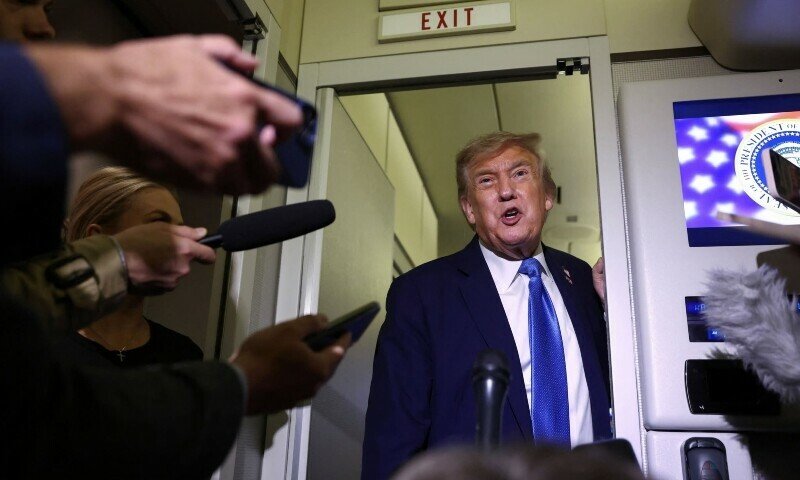
Earlier, Trump told reporters on Air Force One while returning from Canada that he wanted “a real end, not a ceasefire” to the Iran-Israel conflict, and warned that “I’m not in too much of a mood to negotiate.”
After months of attacking Gaza — flattening homes, targeting hospitals, and starving a besieged population — Israel expanded its assault by launching wide-scale air strikes against Iran’s nuclear facilities, military sites and private residences last week, killing top commanders, scientists and civilians..
Israeli officials have claimed the strikes are part of a broader operation codenamed ‘Rising Lion’ to deter Tehran’s nuclear ambitions, which the latter has consistently denied, saying its uranium enrichment programme is for civilian purposes.
Trump said he “wants ‘a real end’ to the nuclear problem with Iran”, while predicting that Israel would not be slowing its attacks on Iran, according to comments shared by CBS journalist Jennifer Jacobs on X.
“You’re going to find out over the next two days. You’re going to find out. Nobody’s slowed up so far,” CBS journalist Jennifer Jacobs quoted Trump as saying on Air Force One.
The US would “come down so hard if they (Iran) do anything to our people”, Trump warned, according to the reporter.
Trump said “I may”, on the prospect of sending US Middle East Envoy Steve Witkoff or Vice President JD Vance to meet with Iran. However, he added that “it depends what happens when I get back”, according to Jacobs.
Later in the day, Vice President JD Vance said, while responding to speculation that the US could intervene in the conflict, that Trump may decide that “further action” is needed to stop Iran’s nuclear programme.
“The president has shown remarkable restraint in keeping our military’s focus on protecting our troops and protecting our citizens. He may decide he needs to take further action to end Iranian enrichment,” Vance said in a post on X.
French President Emmanuel Macron warned any attempt to change the regime in Iran would result in “chaos”. Macron was speaking at a G7 summit in Canada shortly after Trump said the US would not kill Iran’s supreme leader “for now”.
Macron said that Trump had a critical role in restarting diplomacy with Tehran and said he believed the US leader favours a ceasefire between Iran and Israel.
“I believe we need the United States of America to bring everyone back around the table,” Macron told reporters.
Meanwhile, three US officials said that the country’s military was deploying more fighter aircraft to the Middle East and extending the deployment of other warplanes, bolstering US military forces in the region as the war between Israel and Iran rages.
One of the officials said the deployments include F-16, F-22 and F-35 fighter aircraft.
Two of the officials stressed the defensive nature of the deployment of fighter aircraft, which have been used to shoot down drones and projectiles.
The Pentagon did not immediately respond to a request for comment.
Reuters was first to report on Monday the movement of a large number of tanker aircraft to Europe as well as the deployment of an aircraft carrier to the Middle East, providing options to Trump as Middle East tensions soar.
US Defence Secretary Pete Hegseth described the deployments as defensive in nature, as Washington looks to safeguard forces in the Middle East from potential blowback from Iran and Iran-aligned forces in the region.
A fourth US defence official raised the possibility of the deployment to the Eastern Mediterranean of additional US Navy warships capable of shooting down ballistic missiles.
Four US Stratofortress bombers are currently stationed at the Diego Garcia base in the Indian Ocean, according to an AFP analysis of satellite imagery.
The base, leased to the United States by Britain, is one of its key military facilities in the Asia-Pacific region, and was used as a hub for long-range bombers and ships during the wars in Afghanistan and Iraq.
The four B52H Stratofortresses, which can carry nuclear weapons or other precision-guided munitions, were spotted on a southern tarmac at Diego Garcia on Monday at 0922 GMT.
Images provided by Planet Labs indicate they arrived in mid-May.
A C-17 Globemaster III troop and cargo transport plane is also at the base, according to the AFP analysis, as well as six jets likely to be KC-135 airborne refuelling tanker.
The Pentagon said Monday that it was sending “additional capabilities” to the Middle East amid an escalation of the Iran-Israel conflict, while the aircraft carrier USS Nimitz cancelled a Vietnam visit to head toward the Indian Ocean, according to Marine Traffic, a ship-tracking site.
Washington has also redeployed around 30 refuelling planes toward bases in Europe.
The US already has a sizeable force in the Middle East, with nearly 40,000 troops in the region, including air defence systems, fighter aircraft and warships that can detect and shoot down enemy missiles.
Israel launched its air war, its largest ever on Iran, on Friday after saying it concluded Iran was on the verge of developing a nuclear weapon.
Iran denies seeking nuclear weapons and has pointed to its right to nuclear technology for peaceful purposes, including enrichment, as a party to the Nuclear Non-Proliferation Treaty.
US lawmaker Thomas Massie said that he introduced an Iran War Powers Resolution with fellow lawmaker Ro Khanna to prohibit US involvement in the Israel-Iran war.
“This is not our war. Even if it were, Congress must decide such matters according to our constitution,” he said.