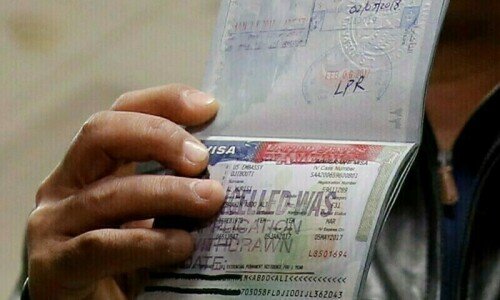
Following new visa rules by the Trump administration, the United States Embassy in India on Monday asked all applicants for F, M, or J nonimmigrant visas to make their social public accounts public for vetting.
US President Donald Trump’s administration on Wednesday ordered the resumption of student visa appointments but significantly tightened its social media vetting in a bid to identify any applicants who may be hostile towards the country, according to an internal State Department cable reviewed by Reuters.
US consular officers are now required to conduct a “comprehensive and thorough vetting” of all student and exchange visitor applicants to identify those who “bear hostile attitudes toward our citizens, culture, government, institutions, or founding principles”, said the cable, which was dated June 18 and sent to US missions on Wednesday.
In a post on X today, the US Embassy in India said: “Effective immediately, all individuals applying for an F, M, or J nonimmigrant visa are requested to adjust the privacy settings on all of their social media accounts to public to facilitate vetting necessary to establish their identity and admissibility to the US under US law.”
It added that since 2019, the US had required visa applicants to provide social media identifiers on immigrant and nonimmigrant visa application forms.
“We use all available information in our visa screening and vetting to identify visa applicants who are inadmissible to the US, including those who pose a threat to US national security.”
F and M are different student visa types, while the J visa is a nonimmigrant visa for individuals approved to participate in exchange visitor programmes in the US.
On May 27, the Trump administration ordered its missions abroad to stop scheduling new appointments for student and exchange visitor visa applicants, saying the State Department was set to expand social media vetting of foreign students.
US Secretary of State Marco Rubio had said updated guidance would be released once a review was completed.
The June 18 dated cable, which was sent by Rubio and sent to all US diplomatic missions, directed officers to look for “applicants who demonstrate a history of political activism, especially when it is associated with violence or with the views and activities described above, you must consider the likelihood they would continue such activity in the US”.
The cable, which was first reported by Free Press, also authorised the consular officers to ask the applicants to make all of their social media accounts public.
“Remind the applicant that limited access to … online presence could be construed as an effort to evade or hide certain activity,” the cable said.
The move follows the administration’s enhanced vetting measures last month for visa applicants looking to travel to Harvard University for any purpose, in what a separate State Department cable said would serve as a pilot programme for wider expanded screening.
Online presence
The new vetting process should include a review of the applicant’s entire online presence and not just social media activity, the cable said, urging the officers to use any “appropriate search engines or other online resources”.
During the vetting, the directive asks officers to look for any potentially derogatory information about the applicant.
“For example, during an online presence search, you might discover on social media that an applicant endorsed Hamas or its activities,” the cable says, adding that this may be a reason for ineligibility.
Rubio, Trump’s top diplomat and national security adviser, has said he has revoked the visas of hundreds, perhaps thousands of people, including students, because they got involved in activities that he said went against US foreign policy priorities.
Those activities include support for Palestinians and criticism of Israel’s conduct in the conflict in Gaza.