“The demolition of the IHC and its independence, that is being witnessed today, is only because the petitioner judges dared to object to the executive’s interference in their judicial work and uphold their oath as judges of the IHC.”

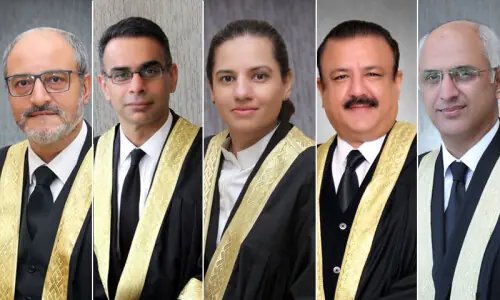
These are the words of five Islamabad High Court (IHC) judges who have moved the Supreme Court (SC) against the IHC itself, and its top judge.
Justices Mohsin Akhtar Kayani, Babar Sattar, Tariq Mahmood Jahangiri, Saman Rafat and Ejaz Ishaq Khan have filed similar petitions in the country’s apex court. Their applications also outline the events that led to them making the move.
Here’s how these events unfolded, as detailed in their pleas.
It began in Justice Aamer Farooq’s tenure
During the tenure of the previous IHC chief justice, now Supreme Court Justice Aamer Farooq, the petitioners had raised the “issue of executive interference in judicial work and attempts to pressurise the judges to influence judicial outcomes in certain cases”.
“These serious concerns” were first brought to the knowledge of the then-chief justice of the IHC, informally, in a meeting of all the judges of the high court. The same concerns were brought to the attention of the then-chief justice of Pakistan, Umar Ata Bandial, during a meeting at his residence in May 2023, and the petitioners continued to raise the issue, along with other administrative matters, in several meetings with the then-IHC CJ.
According to the petitioners, these issues had a “serious impact on the administration of justice and independence of the judiciary”.
“However, no response that would adequately address the serious concerns was forthcoming.”
Subsequently, six IHC judges “felt constrained to formally notify the then chief justice, through a letter dated May 10, 2023, regarding the “attempts to assert pressure to influence judicial outcomes”. These judges also included the ones who petitioned the SC on Friday.
The six judges had recommended to the then-IHC CJ to initiate appropriate proceedings under Article 204 of the Constitution — which deals with contempt of court — to address the matter.
“No proceedings were, however, initiated.”
In this connection, the six IHC judges also met the senior-most judges of the SC — then-CJP Bandial, then-senior puisne judge of the apex court, Qazi Faez Isa, and Justice Ijazul Ahsan — the same month “in another attempt to seek appropriate response from within the institution”.
“However, the attempts to pressurise and intimidate the judges continued and were reported to the relevant offices within the institution.”
Then, in March last year, an SC ruling set aside the dismissal of former IHC senior puisne judge Shaukat Aziz Siddiqui. He had been dismissed as a judge of the high court in October 2018 by the Supreme Judicial Council (SJC) — which decides on cases of misconduct of the judges of the superior judiciary — over a fiery speech he had delivered that year at the Rawalpindi Bar Association targeting a security institution.
In his speech, Justice Siddiqui had accused Inter-Services Intelligence (ISI) of influencing court proceedings and ‘forming benches of its choice’.
In view of the SC’s 2024 ruling and “continued interference by the executive branch in the affairs of the Islamabad High Court,” the six judges had also approached the SJC members and SC judges to “seek guidance on the duty of a judge to report and respond to executive interference through their letter dated March 25, 2024”.
In April, the SC took suo motu notice of the matter, and in the first hearing, the SC directed all stakeholders, including the high courts, to furnish their proposals “as to what should be the institutional response and mechanism to address the issues like the ones raised in the letter.”
But, instead of convening a full court meeting to deliberate and discuss the proposals, then-IHC CJ Farooq “deemed it appropriate to only circulate the order and seek proposals,” the judges regret.
Subsequently, Justices Arbab Tahir, Babar Sattar and Saman Rafat were “constrained” to write letters to the then-CJ, urging him to convene a full court meeting for consultation between members of a collegiate body, as opposed to merely circulating the order, and seeking proposals.
“A full court meeting of the IHC was thereafter convened on April 23, 2024, wherein it was unanimously decided that a formal reporting mechanism and appropriate remedial action shall be taken in cases of any executive interference.”
The proposals were also submitted to the SC, but the matter remains “pending and no substantial proceedings have been conducted since last year”.