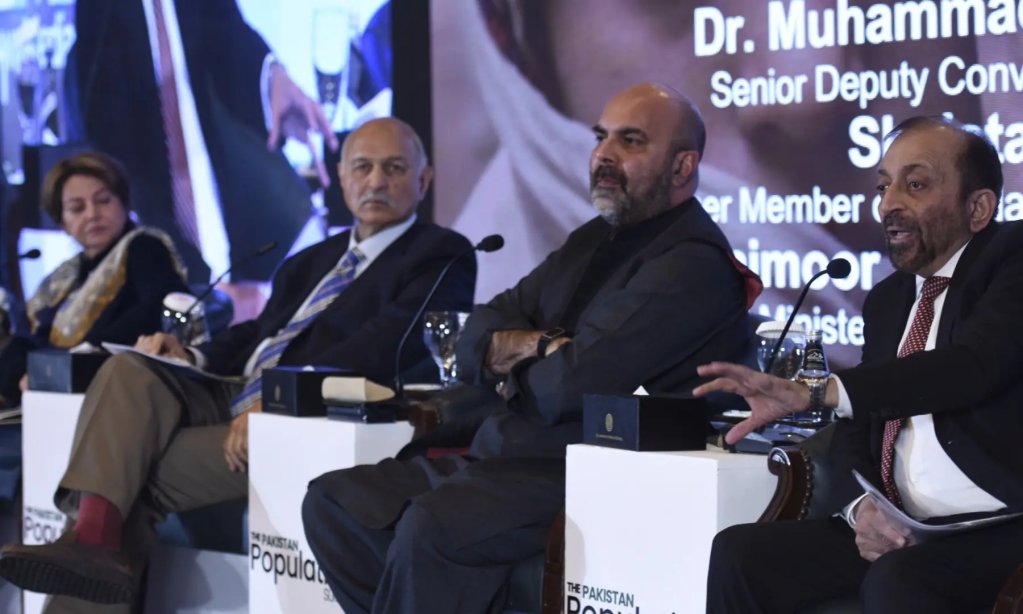
The ‘Pakistan Population Summit’ — a national dialogue on restoring balance and building sustainable futures — has begun in Islamabad to emphasise the need to recognise population planning as an investment in the country’s development.

Organised by DawnMedia, the two-day summit is bringing together politicians, economists, development specialists, private sector leaders, and experts to develop a shared vision as the rising population continues to place pressure on health systems, food and water security, and employment.
Pakistan, with a population of over 241 million, is the fifth most populous country in the world, adding four to five million people every year. Its population growth rate of 2.40 per cent is the highest in South Asia.
The rapid increase is outpacing employment opportunities, with official statistics showing the country will require 104m jobs by 2040. Pakistan will not be able to achieve Sustainable Development Goals (SDGs) by 2030 if the current trajectory of population growth does not slow down.
View the full agenda here.
3:36pm — Population Association of Pakistan president says govts ‘not serious enough’
Population Association of Pakistan President Professor Mehtab S. Karim said that none of the “successive governments after Gen Ayub Khan’s removal” were serious enough about population programming in Pakistan, except for ex-PM Benazir Bhutto.
Prof Karim also brought up Bangladesh as a case study, pointing out the rising contraceptive prevalence rate (CPR) there, leading to the average number of children per woman of two, compared to Pakistan “still struggling” with over three children per woman.
3:27pm — Indonesian envoy details his country’s efforts
Rahmat Hindiarta Kusuma, social affairs coordinator at the Indonesian embassy, noted that Indonesia had ranked among the top six most populous countries since the 1960s.
“However, the international community has considered Indonesia as one of the countries having a strong and successful family planning initiatives in the world,” Kusuma highlighted.
He cited figures of declining fertility rate in Indonesia and rising CPR in the 1990s.
“The crisis gave us very incredible experience,” he said, adding that people learned that having family planning was beneficial for them.
Kusuma recalled that Indonesia organised dialogues and events to promote the importance of family planning, with enforcement encouraged among men as well, not just women.
Rahmat Hindiarta Kusuma, social affairs coordinator at the Indonesian embassy in Islamabad, speaks at the summit. — Mohammad Asim/White Star
3:23pm — ‘Should include chapter on small families in academic curriculum’
Dr Rashid Amjad said there was much to learn from Bangladesh, which had got “some tailwinds” of the youth dividend.
He also mentioned the “flexibility” that Iran and Egypt were trying to build into their population growth strategy. “Egypt is very similar to us […] [President] Sisi is very clear — two-child family,” he said.
Dr Amjad underscored the need to educate the youth about the benefits of “happy, healthy, smaller families”, calling for the topic to be incorporated into primary and higher education curricula.
He also suggested the formation of a high-level “Special Demographic Dividend Facilitation Council”.