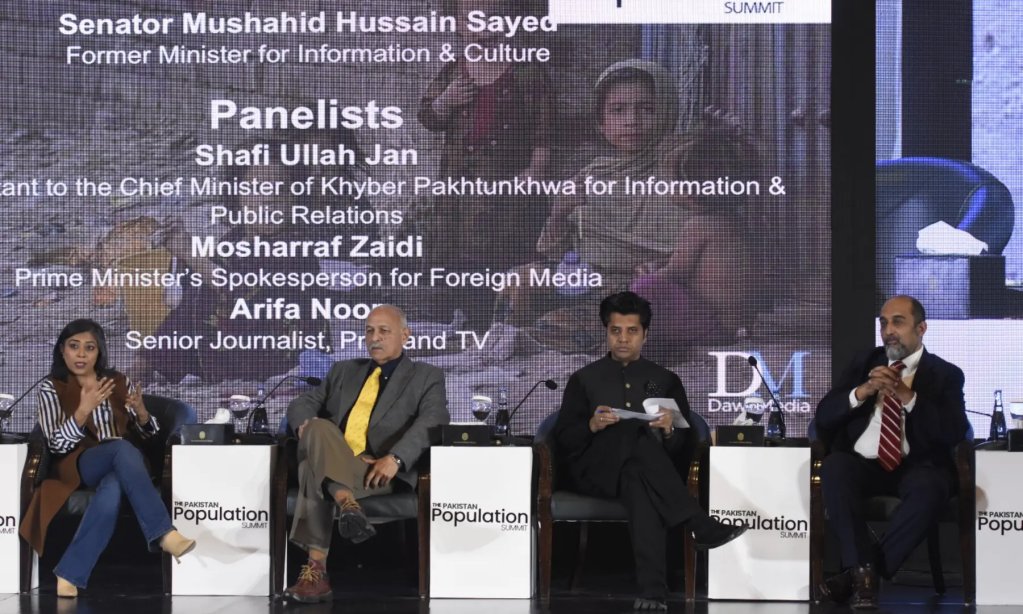
The second and final day of the ‘Pakistan Population Summit’ — a national dialogue on restoring balance and building sustainable futures — concluded in Islamabad on Tuesday.

Organised by DawnMedia, the summit is bringing together politicians, economists, development specialists, private sector leaders, and experts to develop a shared vision as rapid population growth continues to place pressure on health systems, food and water security, and employment.
On Monday, policymakers, experts, diplomats and lawmakers had expressed the unanimous view that prosperity was not possible if the number of mouths to feed kept rising.
They argued that without managing the population in terms of resources, all of the government’s efforts — aimed at development, progress and social uplift — would amount to nought.
View the full agenda here.
2:20pm — Pakistan Population Summit concludes
With the second day of discussions over, the Pakistan Population Summit 2025 has concluded.
Thank you for following our live coverage of the event, which focused on a pressing challenge facing the country, as highlighted by leaders and experts.
2:11pm — KP CM Sohail Afridi addresses summit
KP CM Sohail Afridi’s video message is played at the summit. — Tanveer Shahzad / White Star
2:05pm — Sindh CM calls for urgent, coordinated action
In a video message played at the summit, Sindh CM Murad Ali Shah called for “urgent, coordinated action” to address the realities of the rapidly expanding population.
“Sindh, as one of Pakistan’s most dynamic provinces, feels this pressure keenly. Our growing population is a national strength but it brings profound challenges.”
Sindh CM Murad Ali Shah’s video message is played at the summit. — Tanveer Shahzad / White Star
2:00pm — Tackling population growth requires ‘coordinated and swift’ response: federal health secretary
The federal secretary of the Ministry of National Health Services, Hamed Yaqoob Sheikh, called for the need to adopt a “coordinated and swift response” in tackling population growth.
“Pakistan’s population, which was around 34m at the time of independence, has now increased to around 257m,” he said, adding that “this rapid expansion placed immense strain on our resources.”
“This imbalance is impacting every aspect of national development, our education system, our food security, water security, employment opportunities, urban planning and most critically, our health sector,” he added.
“This is not a sustainable situation and requires a coordinated response and and swift and effective response,” he said.