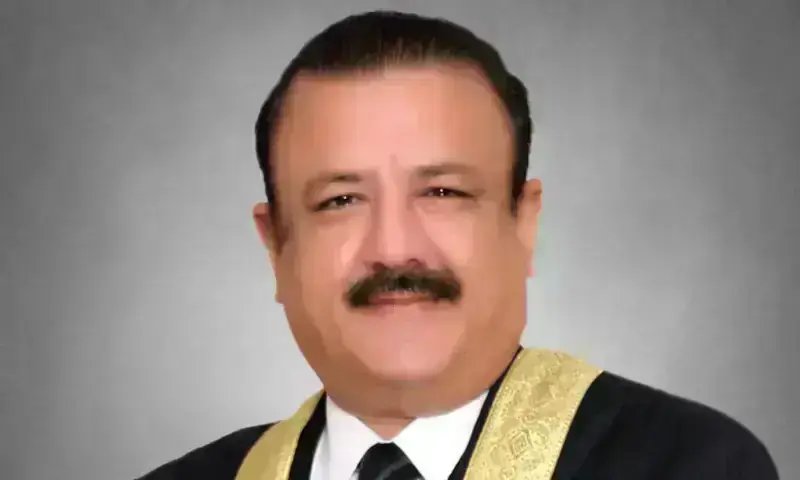
ISLAMABAD: Justice Tariq Mehmood Jahangiri is likely to appear as a defendant before the Islamabad High Court (IHC) to face accusations that surfaced in a petition that challenged his appointment over a controversy related to his law degree.

A division bench comprising Islamabad High Court Chief Justice Sardar Muhammad Sarfraz Dogar and Justice Muhammad Azam Khan will take up the matter for further proceedings on Monday (tomorrow).
In a detailed written order issued on Dec 9, the IHC held that the question regarding the validity of Justice Jahangiri’s law degree fell squarely within the scope of a writ of quo warranto — his right to hold public office.
The two-member bench ruled that the petition was maintainable and set aside the office objection earlier raised by the registrar.
The bench had also granted Justice Jahangiri three days to respond to the facts unearthed till date.
The registrar’s office served the notice at the judge’s chamber due to time constraints. Sources said court staff of Justice Jahangiri received the notice and submitted it to his chamber. They added that Justice Jahangiri decided to appear before the bench at the next hearing.
While Justice Jahangiri along with four other IHC judges — Justices Mohsin Akhtar Kayani, Babar Sattar, Sardar Ejaz Ishaq Khan, and Saman Rafat Imtiaz — had earlier appeared before the Supreme Court as well on the same matter, it is not yet clear whether his fellow judges will accompany him in the IHC on Monday.
However, lawyers are expected to attend the proceedings to express solidarity with him. According to former president of the Islamabad High Court Bar Association Riasat Ali Azad, he, along with scores of lawyers, will be present in the courtroom during the hearing.
Fake degree controversy
The petition, filed by Advocate Mian Dawood under Article 199 of the Constitution, seeks a judicial determination on whether Justice Jahangiri lawfully holds the office of a high court judge in view of allegations concerning his LLB degree obtained from the University of Karachi (KU).
According to the order, the bench observed that the petitioner had challenged the judge’s eligibility to hold office rather than alleging misconduct.
As such, the matter did not fall within the exclusive jurisdiction of Article 209 of the Constitution, which governs proceedings before the Supreme Judicial Council.