• Evidence pushes civilisation timeline beyond 6th century BC
• Uncovered ruins reveal advanced streets and drainage systems
• Pottery, seals, other items indicate thriving commerce before arrival of Greeks

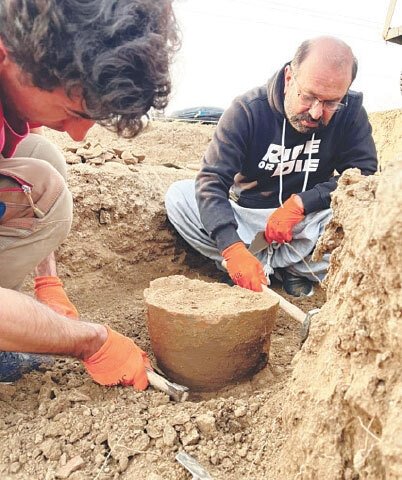
TAXILA: An excavation team working at the ancient remains of Bhir Mound, recognised as the first city of the Taxila Civilisation, has made a major archaeological breakthrough, uncovering compelling evidence of a well-organised urban settlement that predates the sixth century BC.
This significant discovery holds the potential to rewrite the early history of civilisation in the region, suggesting that Taxila was a thriving city centuries earlier than scholars previously believed, existing even before the emergence of Achaemenid or Greek influence.
Mr Dogar described the current discovery as one of the most important in recent decades. He said the evidence confirms Taxila’s role was not merely that of a centre of learning or military activity, but as a fully developed urban civilisation that flourished in the region’s earliest historical phases.
Officials from the Punjab Department of Archaeology, who are currently conducting the extensive excavation at the ancient site, told Dawn on Friday that the newly unearthed remains point definitively to continuous human habitation.
The findings reveal a sophisticated civic structure, placing Taxila among the earliest known urban centres of South Asia.
Archaeologists at the site have uncovered specific remnants such as stone and mud-brick walls, carefully planned street and an advanced drainage system. These structural findings clearly indicates an organised and forward-looking society.
Aasim Dogar, the deputy director of the Punjab Department of Archaeology, said that the current evidence points towards a much older timeline than traditional historical accounts suggest.
“Evidence of second century, fourth century and sixth century culture deposits are found, and the further deep trench may lead to discovery beyond the sixth century,” Mr Dogar said.
He explained that pushing deeper into the stratigraphy may rewrite the history of the first city of Taxila beyond the sixth century BC, creating a historical profile “resembling it to Harappa and Gandhara grave culture”.
Beyond the structural discoveries, a significant number of physical artifacts have been recovered from the site.
Mr Dogar revealed that the team has found finely crafted pottery bearing intricate designs, ancient coins, and seals dating back to the second century B.C. These items reflect established trade networks and include stone and metal tools used in construction and daily life.