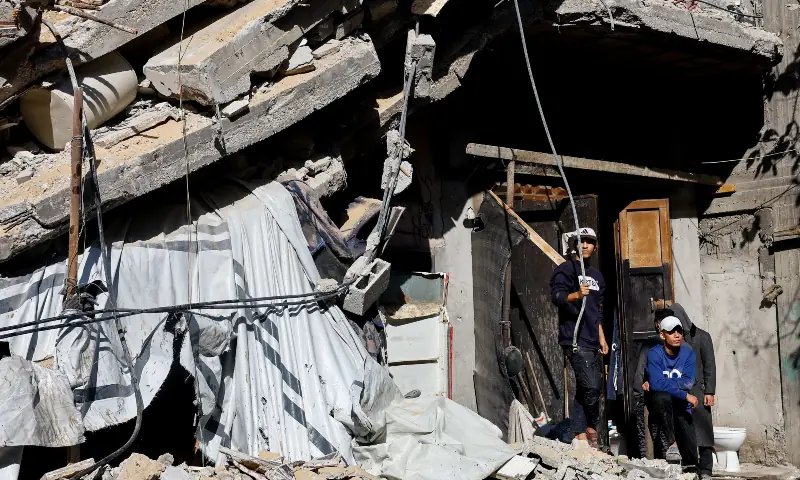
WASHINGTON: Despite deep reservations and fears of domestic backlash, most Muslim-majority countries associated with the Gaza peace process want the proposed International Stabilisation Force (ISF) to succeed, arguing that only such a force can ensure the security and survival of Palestinians in the besieged enclave, diplomats involved in the discussions told Dawn.

“Israel has already killed [more than] 70,000 people in Gaza, and only an international force with a clear mandate can stop this genocide,” said a diplomat from a Muslim nation, directly associated with the process.
Another diplomat acknowledged that participation in the ISF would place contributing states in an extremely difficult position, but said the alternatives were even bleaker.
“We know we would be pushed into a very difficult situation if we joined the ISF,” he said. “But the alternative is even worse — uninterrupted bloodshed in Gaza, and that’s not acceptable to us.”
Diplomats say the choice is a difficult one; warn that Palestinian blood will continue to flow in the absence of proposed ISF
A third diplomat said governments were under no illusion about the political costs at home. “We realise it will not be a popular war. We will be criticised at home too, but we have to get involved,” he said.
The ISF is a central pillar of a US-backed plan for “Phase 2” in Gaza, aimed at stabilising the territory after a ceasefire, training a Palestinian police force, overseeing demilitarisation, and enabling limited reconstruction.
Several Muslim countries — including Egypt, Jordan, Qatar, Saudi Arabia, Turkiye, the United Arab Emirates, Indonesia, Azerbaijan and Pakistan — are involved in discussions around the initiative, though most have stopped short of firm troop commitments.
Diplomats say broad conceptual support exists, but final decisions hinge on unresolved questions about the force’s mandate, authority, rules of engagement and command structure.
The ISF is expected to operate under UN Security Council Resolution 2803, which envisages enforcement of demilitarisation and provision of security, but details remain contested. Reports in the Western media have mentioned Indonesia and Azerbaijan as potential contributors, while Pakistan, Turkiye, Malaysia and Morocco have also shown interest.
Egypt and Qatar — both key mediators between Israel and Hamas — are engaged in talks on ISF’s command structure and have helped establish coordination mechanisms.
At the same time, resistance remains strong.
Israel has explicitly opposed the participation of Turkish troops, citing Ankara’s past political support for Hamas. Saudi Arabia and the UAE have reportedly declined to contribute forces, though both have attended planning conferences. Pakistan, for its part, has conveyed that disarming Hamas would not be its role.
Against this backdrop, The Washington Institute for Near East Policy shared with the media a series of assessments by its senior fellows, warning that without a credible ISF, Israel would insist on retaining broad freedom of military action in Gaza.
“If the ISF is not given a clear mandate and full enforcement powers, or if Hamas refuses to surrender its weapons, Israel will press for continued freedom of action against renewed rearmament efforts, a freeze on any planned Gaza reconstruction efforts beyond the yellow line, and freedom to remain in its current Gaza deployment zones until these issues are addressed,” said Neomi Neumann, an adjunct fellow at the institute.