ISLAMABAD: The death toll from the Islamabad imambargah attack rose to 36 on Saturday, a spokesperson at the Pakistan Institute of Medical Sciences (Pims) confirmed.

The attack occurred at Imambargah Qasr-i-Khadijatul Kubra on the city’s outskirts. The death toll was expected to rise.
“A 21-year-old man, who was brought from the imambargah, died,” said Dr Aneeza Jalil while speaking to Dawn. She added that nine of the injured are in “very serious condition”.
“The number of deaths has reached 33, and nine patients are in very serious condition.”
She further stated that 149 injured and 28 bodies were brought to Pims on Friday following the attack.
Separately, HBS Hospital’s Dr Riaz Janjua confirmed to Dawn that three deaths from the attack were reported at his hospital.
Victims laid to rest
Funerals are taking place on Saturday for some of the victims of a suicide blast at an imambargah in Islamabad during Friday prayers.
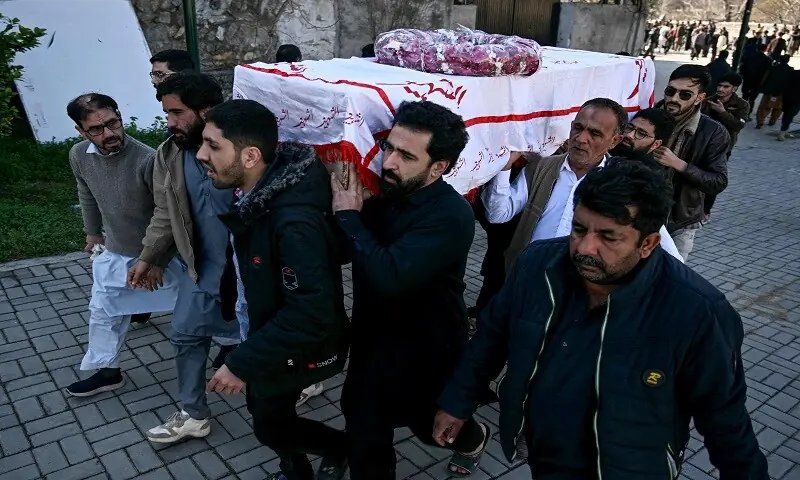
A mass funeral for 13 victims of the Tarlai attack was held in the federal capital, with a large crowd in attendance. Chairman of Interior Affairs Raja Khurram Nawaz attended the prayers.
Inspector Bahadur Ali of Gilgit-Baltistan, martyred in the attack, was also laid to rest with full honours at Police Lines Headquarters.
Senior police officers, including Islamabad IGP Syed Ali Nasir Rizvi, attended the funeral. The body was later dispatched to his native area with full state honours.
“The attacker was stopped at the gate and detonated himself,” a security source told AFP.
Muhammad Kazim, 52, said an “extremely powerful” explosion ripped through the building as prayers were just starting.
Another worshipper, Imran Mahmood, told AFP there was a gunfight between the bomber and volunteer security personnel at the mosque.
Mourners carry the coffin of a victim of the Islamabad imambargah attack on February 7, 2026. — AFP
“The suicide attacker was trying to move forward, but one of our injured volunteers fired at him from behind, hitting him in the thigh,” he told AFP.
He then “detonated the explosives”, Mahmood added.
Friday’s attack was the deadliest in the Pakistani capital since September 2008, when 60 people were killed in a suicide truck bomb blast that destroyed part of the five-star Marriott hotel.
Suicide bomber’s identity
Sources close to the investigation told Dawn that the attacker — whose severed head was found at the crime scene — had been identified as a resident of Gunj, in the walled city of Peshawar. They said that forensic investigators tracked his identity through the Nadra database.
Preliminary investigation suggested that he was linked to the IS militant group and had travelled to Afghanistan multiple times.