• Director of National Intelligence places Pakistan alongside Russia, North Korea; believes their projectiles could reach ‘homeland’ in future
• Lawmakers told Iran govt ‘degraded’, but remains capable of attacking US, Gulf allies
• South Asian militant groups ‘persistent danger’ to US interests, Gabbard warns

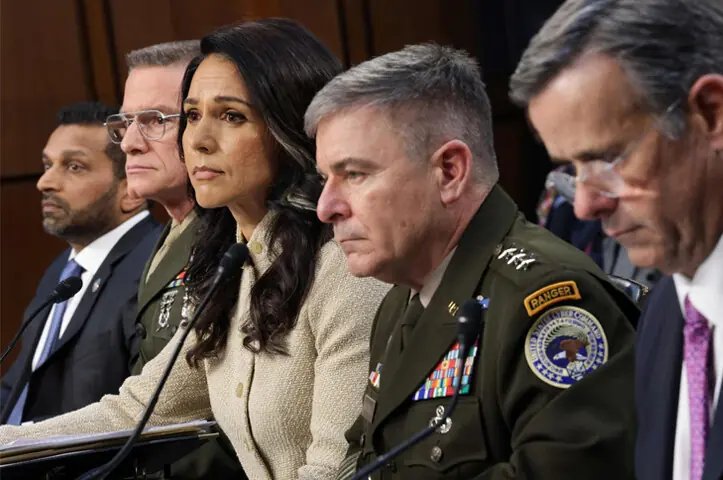
WASHINGTON: US Director of National Intelligence Tulsi Gabbard has listed Pakistan among states that pose a significant threat to the United States, warning US lawmakers that Islamabad’s evolving missile capabilities could potentially put the American homeland within range.
Presenting the 2026 Annual Threat Assessment before the United States Senate Intelligence Committee on Wednesday, Ms Gabbard said, “Russia, China, North Korea, Iran and Pakistan have been researching and developing an array of novel, advanced, or traditional missile delivery systems with nuclear and conventional payloads, that put our Homeland within range.”
“Pakistan’s long-range ballistic missile development potentially could include ICBMs with the range capable of striking the Homeland,” she said.
Ms Gabbard said that the nations identified in the threat assessment report “will likely seek to understand US plans for advanced missile defence… for the purpose of shaping their own missile development programmes and assessing US intentions regarding deterrence.”
She said the intelligence community foresees a sharp rise in missile threats over the next decade. “…threats to the Homeland will expand collectively to more than 16,000 missiles by 2035, from the current assessed figure of more than 3,000 missiles.”
Reacting to the assessment, Washington-based scholar Shuja Nawaz described the inclusion of Pakistan among the principal nuclear threats as a continuation of previous US policy trends. “This continues the analysis of the Biden administration that placed sanctions on Pakistani entities and tried to curb acquisition of new technologies,” he said.
Mr Nawaz argued that most public assessments placed the range of Pakistan’s Shaheen-III missile at less than 2,800 kilometres and that Islamabad has maintained its nuclear programme is aimed solely at deterring India. “There is no reason for Pakistan to target the United States or any other country outside South Asia. Such assessments undermine the budding US-Pakistan relationship,” he said.
“It’s a significant comment, given that the current administration has been fairly quiet on the Pakistan nuclear weapons issue and has generally projected positivity in its messaging on Pakistan,” noted US-based scholar Michael Kugelman.
“But at the same time, I wouldn’t overstate the significance here. Pakistan wasn’t singled out exclusively; it was called out with other countries.” Mr Kugelman added that “while Islamabad would surely prefer not to be clubbed with those that the US views as rogue and pariah states, it’s notable here that the administration was not giving Pakistan special attention.”
South Asia threat assessment
Gabbard also warned in her testimony that, beyond state actors, militant groups operating in South Asia remain a persistent threat to US interests abroad. “They will continue to exploit political instability and ungoverned territory as they seek to rebuild their capabilities and leadership,” she said.
The concern is echoed in the DNI report, which notes that South Asia remains a source of “enduring security challenges” for the United States, particularly due to tensions between Pakistan and India.
About South Asia, the US intelligence community noted that it remained a source of “enduring security challenges”, particularly the relations between Pakistan and India, for the US.
“India–Pakistan relations remain a risk for nuclear conflict given past conflicts where these two nuclear states squared off, creating the danger of escalation,” the report said, while also mentioning the Pahalgam attack that triggered a war between the two neighbours.
“President Trump’s intervention deescalated the most recent nuclear tensions, and we assess that neither country seeks to return to open conflict, but that conditions exist for terrorist actors to continue to create catalysts for crises.”
It also highlighted tensions along the Pakistan-Afghanistan border. “Relations between Pakistan and the Taliban have been tense, with intermittent cross-border clashes, as Islamabad has become increasingly frustrated with anti-Pakistan terrorist groups’ presence in Afghanistan while Islamabad faces growing terrorist violence.”
“Pakistan’s army chief warned this month that lasting peace requires the Taliban to sever ties with militants targeting Pakistan. The Taliban’s public posture has been to call for dialogue, but it has denied harbouring anti-Pakistani militants,” it said, while referring to the ongoing war between the two states.