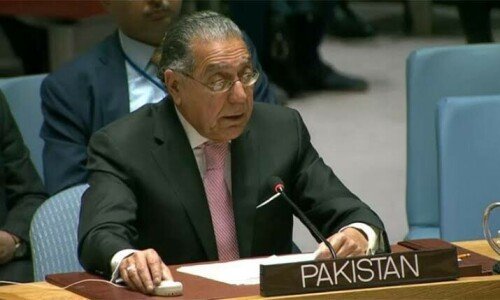
WASHINGTON: On the first day of the new year, Pakistan begins a two-year term as a non-permanent member of the United Nations Security Council (UNSC), stepping into a complex global landscape.

This marks Pakistan’s eighth term on the council, providing an opportunity to shape discussions on pivotal international issues, but also posing significant challenges.
Elected in June to replace Japan, Pakistan now occupies one of the two Asia-Pacific seats on the UNSC. It will preside over the council in July, a key opportunity to set the agenda and foster dialogue.
Pakistan will also secure a seat on the Islamic State and Al Qaeda Sanctions Committee, responsible for designating individuals and groups associated with these organisations as terrorists and imposing sanctions.
Country will preside over UNSC in July, also secures seat on IS, Al Qaeda sanctions committee
This will be a valuable opportunity for Pakistan to highlight cross-border terrorist attacks from Afghanistan by groups with longstanding associations with the militant Islamic State group and Al Qaeda.
While only permanent members hold veto power in the council, non-permanent members wield significant influence in terrorism-related sanctions committees, as decisions are made by consensus under established norms.
However, the fractured state of global politics and increasing polarisation within the council may test Islamabad’s ability to navigate its diplomatic priorities.
Global, regional challenges
Pakistan’s term coincides with heightened tensions in conflict zones such as Gaza, held Kashmir and Syria.
Its longstanding support for Palestine and its advocacy for the Kashmiris’ right to self-determination are expected to feature prominently. Yet, these efforts face entrenched geopolitical obstacles.