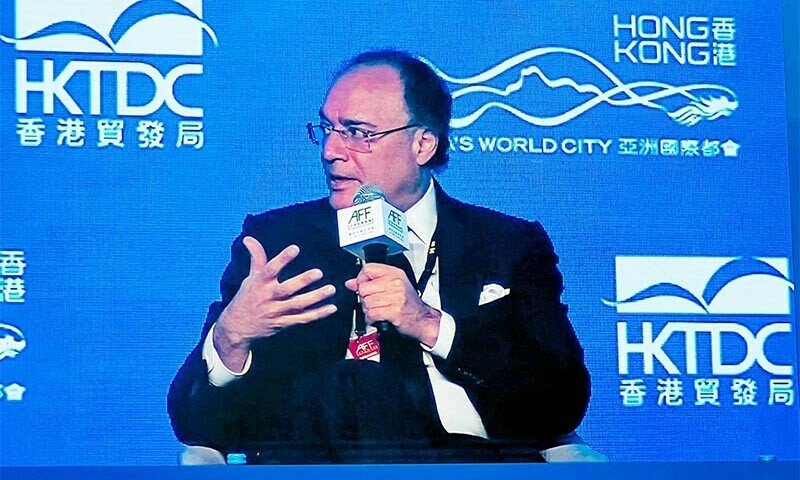
Finance Minister Muhammad Aurangzeb has said that Pakistan was looking to explore more joint ventures with Hong Kong and secondary listings for its firms in the city.

The minister made the remarks during an exclusive interview with the South China Morning Post on Monday, during a two-day visit to attend the Asian Financial Forum 2025.
Aurangzeb’s remarks came ahead of his meeting with Hong Kong’s Chief Executive John Lee Ka-chiu. He highlighted that he would express his interest to the city leader about the possibility of having a delegation from Hong Kong visit Pakistan soon to “identify areas for closer collaboration”.
Furthermore, he said exploring opportunities for Pakistani companies to list in Hong Kong would be a high priority during his meeting with the chief executive.
“If there is an opportunity for companies out of Pakistan, as joint ventures with local companies, to come in and do primary and secondary listings in the Hong Kong stock exchange, for instance, I think it can be a real win-win, not only in terms of the investment that we expect back in Pakistan, but also outward investment,” he said.
According to the report, Aurangzeb said that Pakistani companies and banks had traditionally opted for secondary listings on the London Stock Exchange, noting that local firms had not been aware of Hong Kong’s reputation for international capital raising.
“I would say that Hong Kong can certainly do more in promoting itself as a destination for companies to raise capital,” he added.
Earlier, Aurangzeb had also said that Pakistan was preparing to launch yuan-denominated bonds (panda bonds) this year to shore up its finances — with the country planning to raise $200 million to $250m from Chinese investors over the next six to nine months.
Pakistan is now prioritising Gulf countries for foreign investment, while aiming to unlock greater trade potential with China, Bangladesh, Japan, South Korea, Singapore, Indonesia, Malaysia and Iran. It has also signalled a willingness to normalise trade relations with India under specific conditions.
The International Monetary Fund (IMF) executive board approved a three-year, $7 billion aid package deal for the country in September to enable the country to “cement macroeconomic stability and create conditions for stronger, more inclusive and resilient growth”.