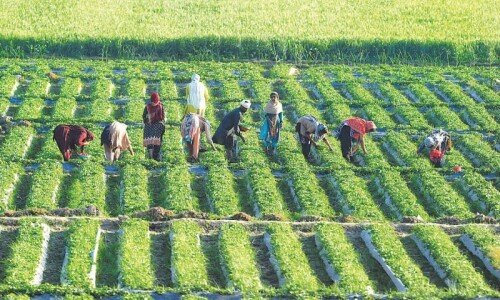
THE water requirements of Pakistan’s agriculture sector, which consumes nearly 90 per cent of the nation’s water, continue to rise due to multiple factors. The sector is striving to meet the food demand of a growing population by increasing crop yields, improving cropping intensity, and expanding cultivated land by reclaiming barren areas like Cholistan. All of these rely, in varying degrees, on water.

Climate change — manifested through rising temperatures and recurring heatwaves — is another factor. The year 2024 was the hottest on record, while the 2010s remained the warmest decade in history. Such rising temperatures have not only increased the water requirements of almost all crops but also exacerbated water losses in irrigation channels.
Most alarmingly, Pakistan’s evolving cropping patterns are increasingly dominated by water-intensive crops, particularly rice and sugarcane. From 2011-12 to 2023-24, the area under rice (paddy) cultivation surged by 41pc, from 2.57 million to 3.63m hectares, while sugarcane acreage grew by 12pc, from 1.06m to 1.18m hectares. Likewise, maize cultivation has also grown significantly by 51pc during the same period.
On the supply side, overall surface water availability is declining due to reduced river flow and diminished storage capacity caused by reservoir sedimentation. Already, per capita water availability has fallen below 1,000 cubic meters, and Pakistan is currently classified as water-scarce.
Alarmingly, Pakistan’s evolving cropping patterns are increasingly dominated by water-intensive crops, particularly rice and sugarcane
Compounding this challenge, the National Drought Monitoring Centre of the Pakistan Meteorological Department has issued an advisory warning of drought-like conditions, as most regions received 40-52pc less rainfall than expected from September 2024 to January 2025.
All these factors have led to indiscriminate groundwater pumping to support water-intensive crops, evidenced by rapidly declining groundwater tables in several districts. This worsening water crisis raises a critical question: has the time come for fundamental policy and strategic adjustments to balance limited water resources with water-guzzling cropping patterns, particularly as climate change further intensifies the strain?
Cropping patterns are typically shaped by a complex interplay of various factors, including soil type, water availability, crop duration, production costs, farming practices, and pest and disease susceptibility.
Nevertheless, in recent years, yield uncertainties due to climate change and market dynamics — determining farmers’ profitability — have assumed primary importance.
The expansion of rice cultivation, in particular, has been fueled by the advent of short-duration (90 days) basmati varieties — Kissan Basmati (1509) — and high-yielding hybrid varieties. Additionally, as an export commodity, rice prices have remained relatively stable, further encouraging its cultivation.
Moreover, these short-duration varieties have enabled farmers in several districts to increase cropping intensity from two to three crops and have also initiated a trend of cultivating two consecutive (sequential) rice crops in a year. While this has boosted Pakistan’s rice exports from $2 billion to $4bn in just a few years, it has placed immense pressure on water resources.
In the case of sugarcane, lucrative indicative (support) prices set by the government annually — until their discontinuation in 2024-25 — have played a key role in expanding its acreage over the past few years.
Given the declining availability of surface water, decreasing rainfall due to climate change, and a stressed groundwater aquifer, the current cropping patterns — dominated by rice and sugarcane cultivation — are unsustainable. Therefore, some urgent policy and strategic adjustments are highly essential.
Many countries have successfully reduced agricultural water consumption by promoting water-efficient irrigation techniques. Pakistan, however, has struggled to achieve significant results in such endeavours. In particular, water-saving techniques in rice cultivation, such as ‘direct seeding of rice’ and ‘alternate wetting and drying’, have failed to gain widespread adoption.
Another potential solution is crop zoning. In select districts of Punjab, restrictions could be imposed on rice cultivation while encouraging farmers to grow low-delta Kharif crops. A precedent for such measures already exists in Sindh, where farmers in certain districts on the left bank of the Indus River are prohibited from growing rice, primarily to address waterlogging. However, such a policy decision needs extensive debate in the country to develop consensus.
A far better approach is to focus on market-driven solutions that enable farmers to earn comparable incomes from alternative crops but with fewer agricultural inputs and hassles. For instance, sesame, with its low water requirements and strong export potential — reaching $414m in 2023-24 — presents a compelling option.
Progressive farmers are already getting over 15 maunds per acre yields by adopting improved seed varieties, ridge sowing, pre-emergence weed control, and balanced nutrient application. This has enabled them to earn higher profits than those from cotton, rice, and other Kharif crops. With 376,000 hectares under sesame cultivation in 2023-24, the area could expand further if the government strengthens the value chain and promotes its value addition within the country.
In conclusion, a strategic shift towards cultivating low-delta crops such as sesame, sunflower, groundnut, pulses, sorghum, guar, and millets is essential for conserving dwindling water resources for future generations.
Furthermore, this shift serves as a powerful tool for climate change mitigation by reducing emissions of methane and nitrous oxide, which are produced in large quantities by flooded rice fields.
Khalid Wattoo is a farmer and a development professional, and Chaudhary Mohammad Ashraff is the former Director General (On-Farm Water Management) of the Punjab Agriculture Department.
Published in Dawn, The Business and Finance Weekly, February 10th, 2025
Follow Dawn Business on Twitter, LinkedIn, Instagram and Facebook for insights on business, finance and tech from Pakistan and across the world.