• At UN Security Council, FM Dar calls for global financial reform; expresses support for peace in Palestine
• Calls for fresh approach to deal with terrorism; discusses economic and strategic ties with Chinese counterpart

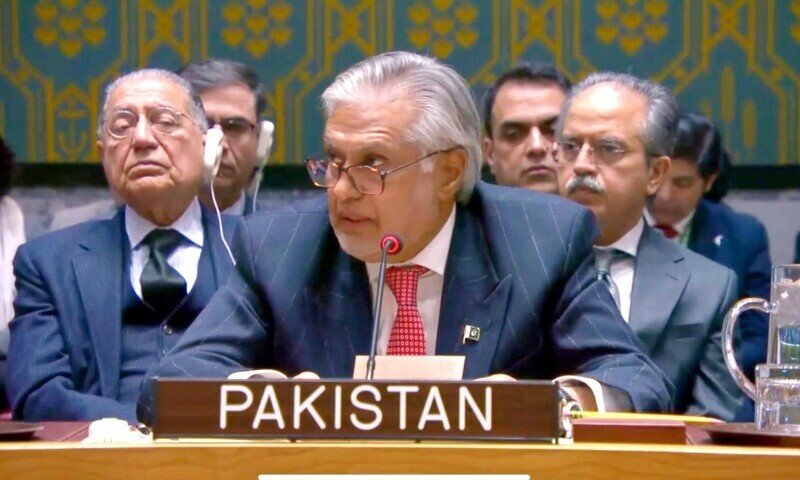
WASHINGTON: On his first visit to the US after the Trump administration took office, Deputy Prime Minister and Foreign Minister Ishaq Dar boasted that Pakistan had broken its diplomatic isolation through active diplomacy, and called for sweeping global reforms and strengthening the UN to create a more inclusive international order.
In remarks made on separate occasions, Mr Dar said Pakistan was no longer isolated in the global community, adding that the country’s economy was set to take off as a result of his government’s hard work.
Addressing a high-level UN Security Council debate hosted by China, Mr Dar underscored the urgent need for restructuring both the UN and global financial institutions.
The existing frameworks have “failed to resolve long-standing conflicts and economic disparities”.
He pointed to unresolved crises — the war in the Middle East and Jammu and Kashmir dispute — and criticised the UN’s inability to enforce its resolutions and uphold its core principles.
He stressed the need for a system that is “more democratic, representative, and accountable,” one that truly serves the interests of all nations rather than a privileged few.
The foreign minister also reiterated Pakistan’s firm stance on India-held Kashmir, emphasising the right to self-determination for Kashmiris as enshrined in UN Security Council resolutions.
The minister said the ongoing tragedy in Palestine was evidence of “the failure to uphold the [UN] Charter and its principles”.
The January 15 ceasefire agreement between Hamas and Israel “offers a glimmer of hope” for a permanent ceasefire, Mr Dar added.
He also called for immediate and adequate aid to the Palestinian people.
He said Pakistan “fully supports the ceasefire agreement” and sees the two-state solution as “the only viable path to lasting peace between Israel and Palestine.”
The foreign minister called for a unified, non-discriminatory approach to combat terrorism, rejecting double standards in dealing with extremist threats.
He noted Pakistan’s sacrifices in the fight against terrorism and emphasised the need for an international strategy that does not conflate legitimate struggles for self-determination with terrorism.
He also highlighted cross-border threats from Afghanistan, particularly attacks by the Tehreek-i-Taliban Pakistan.
While reaffirming Pakistan’s commitment to regional stability, he called on the Afghan government to take decisive action against terrorist groups operating from its soil.
Despite security challenges, Pakistan remained committed to supporting Afghanistan’s humanitarian needs and long-term economic development, he added.