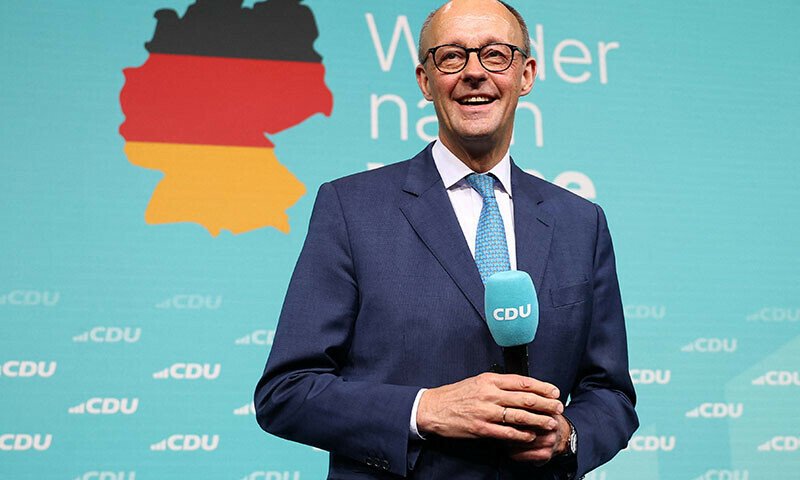
Germany’s opposition conservatives won the national election on Sunday, putting leader Friedrich Merz on track to be the next chancellor while the far-right Alternative for Germany (AfD) came in second, its best-ever result, exit polls showed.

Following a campaign roiled by a series of violent attacks and interventions by US President Donald Trump’s administration, the conservative CDU/CSU bloc won 28.5 per cent of the vote, followed by the AfD with 20pc, an exit poll published by ZDF public broadcaster showed.
Chancellor Olaf Scholz’s Social Democrats (SPD) tumbled to their worst result since World War Two, with 16.5pc of the vote share, according to the ZDF exit poll.
“This is a bitter election result for the Social Democratic Party, it is also an electoral defeat,” Scholz said in a first reaction. “Congratulations on the election result,” he said in remarks directed towards Merz.
The Greens were on 12pc while the FDP hovered around the 5pc threshold to enter parliament. A late campaign surge by the far-left Die Linke (The Left) party gave it 9pc of the vote while breakaway leftist party BSW led by Sahra Wagenknecht squeezed in on 5pc.
The results set the stage for protracted coalition talks and likely mean a three-way coalition made up of one or two of the three same parties that were part of Scholz’s unpopular alliance that collapsed in November.
Merz, 69, has no previous government experience but has promised to provide greater leadership than Scholz and to liaise more with key allies, restoring Germany to the heart of Europe. He said that Germany’s conservatives will do everything they can to form a government capable of taking action as quickly as possible.
“Tonight we will celebrate and from tomorrow we start working,” he said in a first reaction in Berlin, surrounded by supporters. “The world out there is not waiting for us.
A brash economic liberal who has shifted the conservatives to the right, he is considered the antithesis of former conservative Chancellor Angela Merkel, who led Germany for 16 years.
Short of a majority in an increasingly fragmented political landscape, however, his conservatives will have to sound out partners to form a coalition.
Those negotiations are certain to be tricky after a campaign which exposed sharp divisions over migration and how to deal with the AfD in a country where far-right politics carry a particularly strong stigma due to its Nazi past.