Pakistan has urged the UN Security Council (UNSC) to fulfil its responsibility by ensuring the implementation of its own resolutions on the Jammu and Kashmir dispute.

In August 2019, Modi’s ruling Bharatiya Janata Party (BJP) had revoked occupied Kashmir’s special status by repealing Article 370 of the Indian constitution. The country’s Supreme Court had upheld that order in December 2023.
Soon after the elections in November last year, the legislative assembly of IoK had called for the restoration of the region’s special status but Modi rejected that demand.
The two countries saw a heated exchange in January this year as the military strongly reacted to the Indian army chief calling Pakistan the “epicentre of terrorism”.
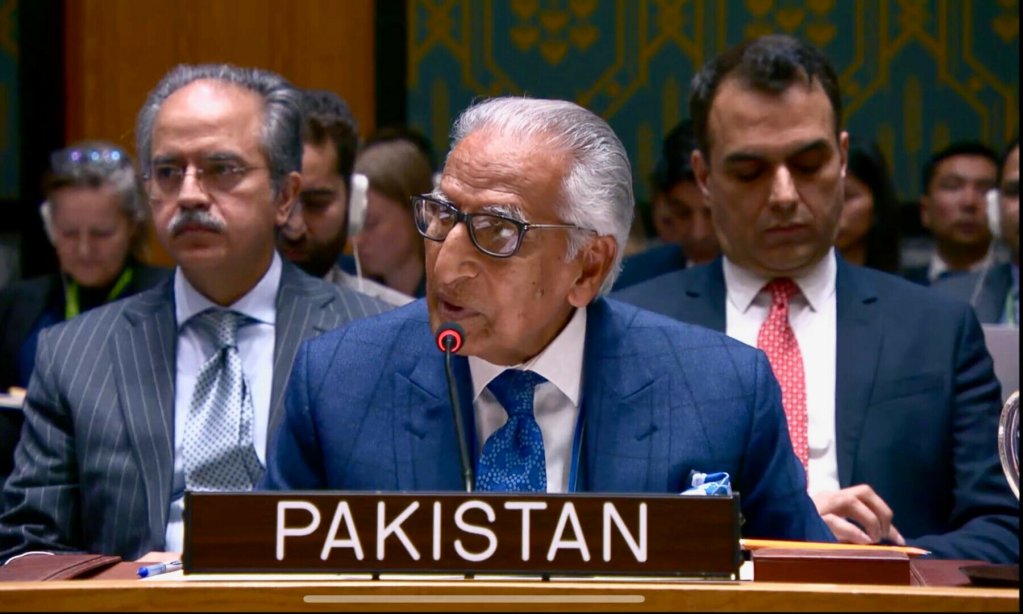
Special Assistant to the Prime Minister (SAPM) and Minister of State for Foreign Affairs Tariq Fatemi told a high-level UNSC meeting on Monday that it was the council’s responsibility to ensure the right to self-determination “for the Kashmiri people, and promote a just and lasting settlement of the Jammu and Kashmir dispute by taking measures to implement its own resolutions”.
Pakistan reminded that the Jammu and Kashmir dispute remains on the agenda of the UNSC and awaits a just and final settlement in accordance with the relevant resolutions of the Security Council that promised the Kashmiri people the right to self-determination through a UN-supervised plebiscite, a press release by the Pakistan Mission to the UN said.
According to the Associated Press of Pakistan, Fatemi made these remarks while speaking at the UNSC high-level open debate on the ‘Maintenance of International Peace and Security: Advancing Adaptability in UN Peace Operations — Responding to New Realities’.
The UNSC statement continued, “Pakistan emphasised that it was the responsibility of the Council to ensure the realisation of that right for the Kashmiri people, and promote a just and lasting settlement of the dispute by taking measures to implement its own resolutions.
“Highlighting the importance of the UN peacekeeping operations as being cost-effective instruments to maintain international peace and security, [Fatemi] mentioned that the UN Military Observer Group in India and Pakistan, established in 1949, exemplified the observation and monitoring type of operations for inter-state conflicts.”
Fatemi was quoted as having said that originally conceived for inter-state conflicts, peacekeeping operations have since also been applied in intra-state conflicts and civil wars.
The SAPM mentioned Pakistan’s long association with UN peacekeeping operations in terms of being one of the longest-serving and leading troop contributors and a founding member of the Peacebuilding Commission.