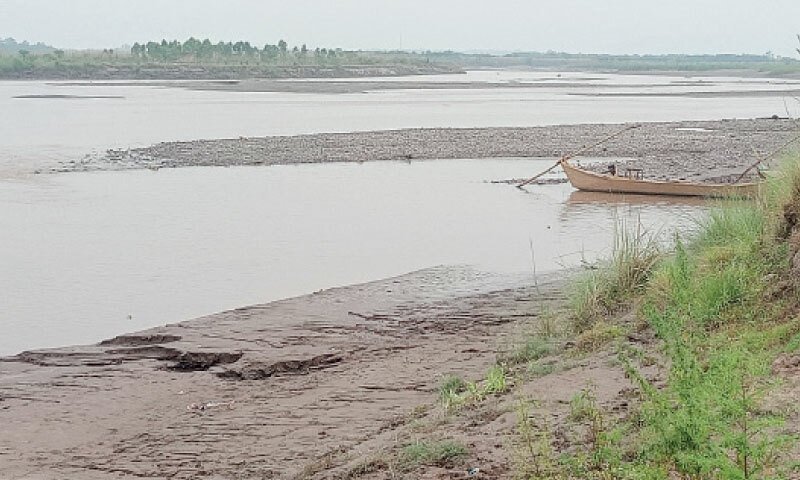
• Pakistan’s waters being used to fill up three Indian reservoirs with total capacity of 1.2MAF; official says sudden discharge could create a ‘flood-like’ situation
• Decreased inflows at Marala will result in more water shortage for crops, Irsa warns
• Reuters report claims New Delhi plans to boost reservoir holding capacity at two hydroelectric projects

NEARLY a week after its unilateral suspension of the Indus Waters Treaty, India on Monday virtually stopped water discharges from the Chenab River into Pakistan without prior notice, reducing flows in the river manifold.
Water flows in the Chenab, recorded at the Marala headworks, decreased from up to 35,000 cusecs on Sunday to about 3,100 cusecs on Monday morning.
“They have almost blocked the River Chenab flows to downstream (Pakistan) after they (Indian authorities) took the decision on Sunday,” a senior official of the Punjab irrigation department confirmed on Monday.
“Currently, they are using our water to fill up their dams/hydropower projects in the Chenab basin. They cannot do this since it is a grave violation of the Indus Water Treaty…,” the official deplored.
According to a document seen by Dawn, India has three major hydropower projects in the Chenab Basin. The first is the 1,000MW Pakal Dul Dam, having an 88,000 acre-feet reservoir storage capacity and a 10km head race tunnel to divert water south.
The second is the Baglihar Dam (88km from Pakal Dul upstream). This is a 900MW power generation plant, having a 321,002 acre-feet reservoir storage along with a spillway capacity of 582,692 cusecs.
The third one is Salal Dam, located 78km from Baglihar, having an installed power generation capacity of 690MW along with 228,000 acre-feet reservoir storage and spillway capacity of 792,012 cusecs.
“From Salal Dam, Marala Barrage (in Pakistan) is situated 76km away. The reason behind the massive reduction in the flows is the filling of these dams, which have a total storage capacity of over 1.2 million acre-feet. And if they keep filling their dams and avert discharging, they (India) may leave us without water for four to five days more,” the official warned.
To a question, he said that if India suddenly started discharging water downstream, there could be a flood-like situation in Chenab, putting the local population at risk.
To another question, he said Marala’s capacity was 1.1 million cusecs, whereas the total storage capacity of India’s dams in the Chenab basin was over 1.3 million acre-feet. “However, they don’t have control over the water inflows to Pakistan in the river from the Jammu-Tavi and Munawar-Tavi distributaries,” the official added.
According to the official, Chenab is very important for Pakistan’s irrigation system, as its canals, including the UCC and BRB canals, irrigate a vast tract of agricultural land in Punjab.
According to the daily water report issued by the Water and Power Development Authority (Wapda), the water inflows in Chenab at Marala were recorded at 5,300 cusecs, whereas there were zero outflows on Monday.
The inflows and outflows in the river at Marala on Sunday were 34,600 and 25,400 cusecs, respectively.
Shortage for Kharif crops
Separately, a meeting of the advisory committee of the Indus River System Authority also expressed concerns over the unilateral Indian decision that would cause additional shortages to Kharif crops, already facing an estimated 21pc shortfall.
“…sudden decrease in river Chenab inflows at Marala due to short supply by India would result in more shortages in early Kharif season,” said a statement issued by Irsa. The water regulator declared an overall shortage of 21pc for the remaining early Kharif season in case supplies in River Chenab remained normal. However, the situation would be monitored on a daily basis and if the decrease continues, the shortages would be revisited accordingly, Irsa said, adding the late Kharif shortages were expected to be 7pc.
An official told Dawn that Chenab flowed at 35,600 cusecs on Sunday at Marala headwork, but dropped to 3,177 cusecs on Monday morning, showing a reduction of almost 11 times. He said three storages — Baglihar, Dulhasti and Salal — on Chenab in Kashmir had the capacity to stop river flows.
Sindh’s concerns
Sindh representatives recorded their objections over the operationalisation of Chashma-Jhelum Link Canal by Punjab, but was explained that Punjab was using its own share. Sindh, nevertheless, insisted that the opening of the emergency link canal affected Sindh’s allocated share downstream.