WASHINGTON: Amid easing tensions following a ceasefire between India and Pakistan, President Donald Trump has claimed that US intervention prevented a “bad nuclear war” between the two nations, while Prime Minister Narendra Modi in a televised address to the nation asserted that New Delhi would not tolerate “nuclear blackmail” in the event of further conflict with Islamabad.

Trump’s comments, made during a press interaction at the White House, signal a rare moment of US diplomatic mediation between the two South Asian nuclear powers and suggest a broader American strategy that ties peace to economic engagement.
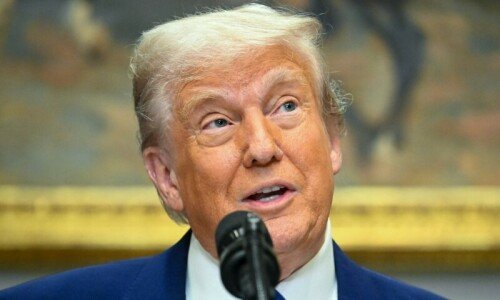
“We stopped a nuclear conflict. I think it could have been a bad nuclear war. Millions of people could have been killed,” Trump said while talking to reporters.
This is perhaps one of the starkest warnings yet from the US leader, who has rarely minced words in highlighting global security threats. His remarks reflect Washington’s growing concern about the fragile peace between India and Pakistan, both of whom possess significant nuclear arsenals and a long history of military confrontations.
In a tone that combined both reassurance and transactional diplomacy, Trump added that the United States is prepared to enhance trade with both countries — if they continue to engage in dialogue. “We’re going to do a lot of trade with Pakistan. We’re going to do a lot of trade with India. We’re negotiating with India right now. We’re going to be soon negotiating with Pakistan,” he said, linking the prospect of economic cooperation to continued regional stability.
Trump, who appeared eager to underscore his administration’s peacemaking role, said: “On Saturday, my administration helped broker an immediate ceasefire, I think a maybe permanent one between India and Pakistan — the countries having a lot of nuclear weapons.”
His assertion, while dramatic, underscores the high stakes involved in this latest confrontation and his belief that trade can be a powerful tool of diplomacy.
He also praised the leadership of both countries for their roles in defusing the situation. “I’m very proud to let you know that the leadership of India and Pakistan was unwavering and powerful, but unwavering in both cases — they really were from the standpoint of having the strength and the wisdom and fortitude to fully know and to understand the gravity of the situation,” he said.
Trump also offered a unique insight into how he leveraged economic incentives to push both sides toward de-escalation.
“We helped a lot, and we also helped with trade. I said ‘Come on, we’re going to do a lot of trade with you guys. Let’s stop it, let’s stop it. If you stop it, we’re doing trade’,” he said. He then added: “If you don’t stop it, we’re not going to do any trade. People have never really used trade the way I used it. By that, I can tell you, and all of a sudden they said. I think we’re gonna stop, and they have.”
In concluding his remarks, the president emphasised once again the magnitude of what he believed had been averted. “We stopped a nuclear conflict,” he declared, before offering thanks to members of his administration. “I also want to thank VP JD Vance and Secretary of State, Marco Rubio, for their work,” he said, crediting them for helping facilitate the peace process.
While the claims made by President Trump will be scrutinised in Washington and South Asia, they do indicate a willingness on the part of the US to reassert its role as a mediator in global conflicts. Whether these efforts translate into a lasting peace between India and Pakistan, however, remains to be seen.
‘Nuclear blackmail’
Indian PM Modi vowed on Monday to respond strongly to any future “terrorist attack”, and cautioned that India would not succumb to ‘nuclear blackmail’ in the face of future provocations.
A weekend ceasefire which Trump said he brokered appeared to be holding on Monday after four days of intense jet fighter, missile, drone and artillery attacks — the worst violence between the two nuclear-armed neighbours since 1999.
The conflict followed an April 22 attack on tourists in Pahalgam, in India-held Kashmir, which killed 26 civilians.