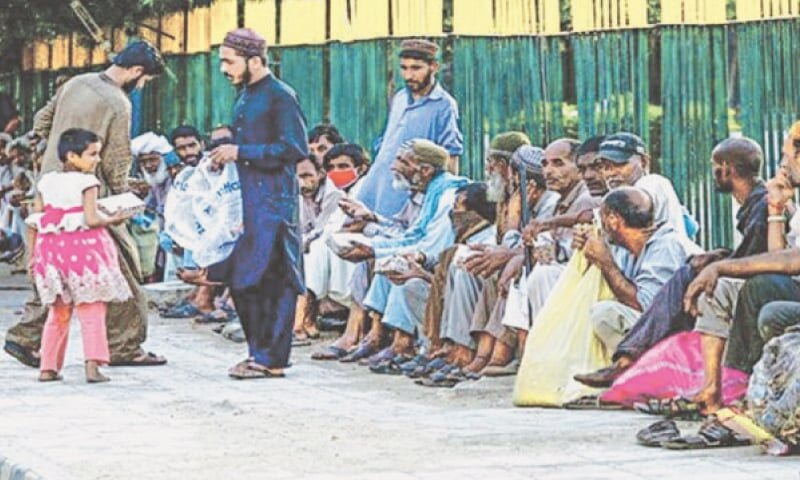
ISLAMABAD: Almost forty-five per cent of Pakistan’s population lives below the poverty line, according to a World Bank report released on Thursday.

The finding, based on a survey conducted in 2018-19, comes in the wake of an update of global poverty lines made by the bank, and not because of any change in underlying economic conditions across the world.
The proportion of people living in extreme poverty has risen from 4.9pc to 16.5pc, according to the report.
The latest findings come in the wake of World Bank’s update of global poverty lines and not because of any change in the underlying economic conditions across the world.
Poverty assessments revised to reflect changes in cost of living and consumption habits
“For Pakistan, the poverty rate based on the new $3 international poverty line (IPL) under 2021 purchasing power parity (PPP) is 16.5Pc, compared to 4.9pc under the previous $2.15 line (2017 PPP),” said the World Bank.
About 82pc of this increase is due to the higher value of the new IPL, reflecting increases in the national poverty lines of comparator countries, with the rest explained by price increases in Pakistan between 2017 and 2021 reflected in the updated PPPs, it added.
“The poverty rate under the $4.20 IPL line rose from 39.8pc to 44.7pc” in Pakistan, the bank said. It added that the new IPL affected the level of poverty only, but trends in poverty remain unchanged.
Old definition
Under the World Bank’s old definition of $2.15 per capita threshold for low income countries (LICs), 4.9pc of Pakistan’s population was considered living in extreme poverty. The percentage has now surged to 16.5 with the new threshold of $3 per day under the same 2018-19 survey. Pakistan has not conducted household income survey since then.
Measured by $4.2 per capita income for lower middle income countries (LMICs), the poverty rate in Pakistan has increased to 44.7pc from 39.8pc estimated earlier at $3.65 per day, explained Christine Wieser, a World Bank poverty expert, at a news conference here.
She said Pakistan’s poverty and resilience assessment (PERA), currently in progress, would provide the latest update on actual poverty situation on the ground and explore drivers and dimensions of trends in poverty and welfare over the past 20 years.
The findings, due in September this year, would also have special deep dives on spatial disparities and fiscal equity.
Ms Wieser said the poverty rate in Pakistan was up 88.4pc, based on $8.30 a day — the poverty line meant for upper middle income countries (UMICs).
Earlier, 84.5pc Pakistanis fell in this category at the old threshold of $6.85 a day.
The bank changed its global poverty lines to reflect changes in the cost of living and consumption habits of people around the world, based on newly available data. The new poverty lines are $3 per person per day for low income countries, $4.2 for lower-middle-income countries, and $8.3 for upper-middle-income countries.
These lines are based on 2021 purchasing power parity rates, as well as updated national poverty lines.
In reply to a question whether this meant policy formulations were misplaced, Ms Wieser said countries used their own national poverty lines and surveys to monitor the evolution of poverty and guide anti-poverty policies and investments.