• Bilawal urges world to stand against Indian aggression, says water an existential issue for Pakistan
• Ex-US diplomat endorses call for neutral Pahalgam probe, regrets Pak-US ties ‘still stuck in the past’
• VP Vance meets Indian delegation as US officials assure Pakistan of ‘equal representation’

WASHINGTON: As fomer foreign minister Bilawal Bhutto-Zardari blamed India for pushing South Asia towards the first nuclear war over water, a former US ambassador to Pakistan endorsed Islamabad’s demand for an independent inquiry into the Pahalgam incident, which led to a full-blown conflict between Islamabad and New Delhi.
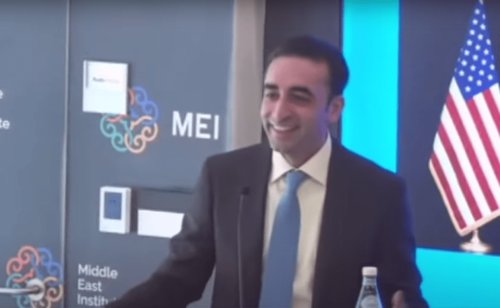
At a policy forum hosted by the Middle East Institute (MEI) in Washington, former US ambassador to Islamabad Anne Patterson stressed that the United States-Pakistan relationship was hindered by mistrust, despite ongoing security cooperation.
“The US-Pakistan relationship is so stuck in the past that India was not required to present any forensic or investigative evidence after the Pahalgam attack,” Ms Patterson said.
“It (India) had simply said that Pakistan was still engaged in terrorism. And international observers, I hate to say, tended to believe this claim.”
She added, “This incident almost led to a nuclear war, and it’s critically important to get to the bottom of what happened. An independent investigation, possibly by agencies like the FBI or Scotland Yard, should be the first step.”
Mr Bhutto-Zardari highlighted Pakistan’s core concerns: terrorism, Kashmir, and the ongoing water dispute with India. “Water wars used to be a theory. India shutting off Pakistan’s water supply is laying the foundation for the first nuclear water war,” he said, referring to repeated violations of the Indus Waters Treaty.
“We have said that cutting off our water supply will be an act of war. We don’t say it in a jingoistic manner… It’s an existential crisis for us. Any country would fight for its survival and for its water,” he added, urging global powers to take a firm position against what he described as Indian aggression.
Balancing act
Delegations from both countries are in Washington this week, engaging with US officials, who are trying to strike a delicate diplomatic balance.
The Pakistani delegation includes Senator Sherry Rehman, former foreign minister Hina Rabbani Khar, Dr Musadik Malik, Engineer Khurram Dastgir, Faisal Subzwari, Tehmina Janjua, Senator Bushra Anjum Butt, and Jalil Abbas Jilani.
The Indian delegation is led by Congress MP Shashi Tharoor and includes Shambhavi Chaudhary (Lok Janshakti Party), Sarfaraz Ahmed (Jharkhand Mukti Morcha), G. M. Harish Balayogi (Telugu Desam Party), Shashank Mani Tripathi, Tejaswi Surya, and Bhubaneswar Kalita (all from the BJP), Mallikarjun Devda (Shiv Sena), former Indian Ambassador to the US Taranjit Singh Sandhu, and Shiv Sena MP Milind Deora.
The Indian delegation met US Vice President JD Vance on Thursday, taking advantage of his links to India.
Michael Kugelman, a US scholar of South Asian affairs based in Washington, described the visits as “a high-octane diplomatic effort on both sides meant to secure buy-in from Washington on key positions at a high-stakes moment for both Islamabad and New Delhi”.
He noted that India’s approach is “especially striking” as New Delhi typically avoids internationalising its bilateral disputes.
Mr Kugelman explained: “India’s position is that Pakistan isn’t sufficiently acting against terror. … For Pakistan, it’s about getting Washington to view New Delhi in ways that it tends not to: as untrustworthy and as an aggressor. In effect, each side is trying to not only advance its narratives but also change perceptions in Washington.”