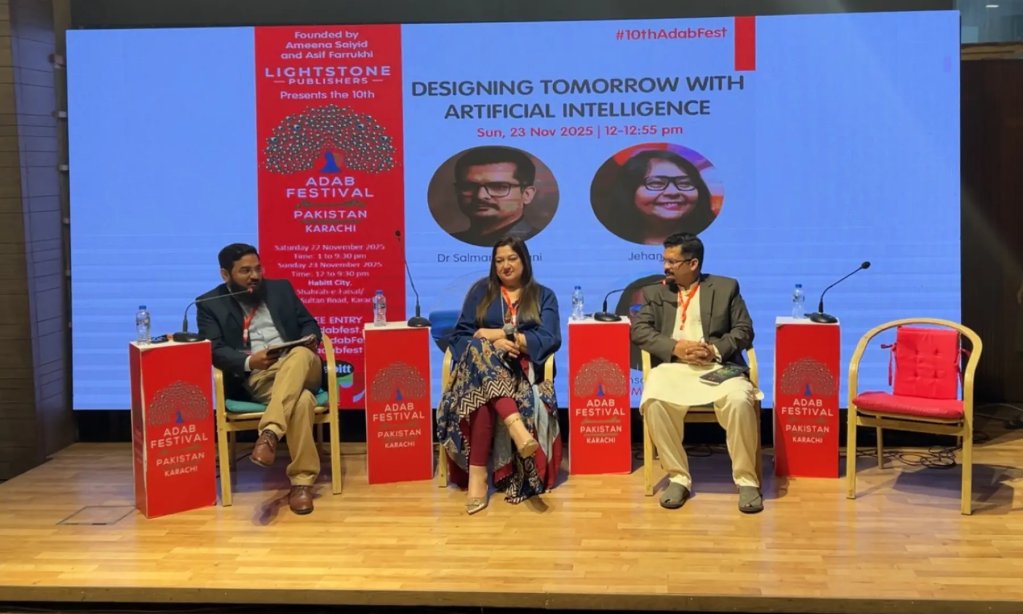
As artificial intelligence continues to reshape daily life, speakers at Karachi’s Adab Festival gathered at Habitt City on Sunday to discuss how the technology has evolved, what it offers, as well as the blind spots and ethical risks it now poses for the future.

The session, titled Designing Tomorrow with Artificial Intelligence, featured Dr Salman Khatani and Sadaf Bhatti, with Ahsan Siddiqui moderating. Entrepreneur Jehan Ara was scheduled to attend but was unable to do so.
Siddiqui began by noting how quickly technological trends shift, recalling earlier waves, from AutoCAD to digital marketing and e-commerce, before today’s AI boom. He pointed out that while people eagerly use tools like ChatGPT or Gemini for tasks such as grammar fixes or image edits, far fewer understand how such systems can be used to create new tools themselves.
“Change is the only constant,” he said, while raising a broader question about the technology’s origins.
Bhatti traced AI’s emergence to 1956 and the study of neurons; historically, that year is known for John McCarthy coining the term ‘artificial intelligence’ at the first AI conference at Dartmouth College.
According to Dr Khatani, large language models (LLMs) enable students to access advanced knowledge in local languages, a feature that, for example, allowed him to teach a seven-year-old the concept of relativity in a regional language (something previously unheard of without an LLM).
“These tools empower the next generation to access knowledge in their native languages and transform their families’ lives,” he said.
Citing Collins Dictionary’s designation of ‘vibe coding’ as word of the year, he said young people can now design applications and games without knowledge of machine learning or deep learning. “Now humans must return to creativity, diversity and empathy, while machines handle logic and engineering,” he said.
Vibe coding can be understood as the practice of prompting AI tools to generate code rather than writing code manually. Despite tradeoffs, fewer barriers to entry make it easier for non-specialists to build projects with relative ease.
Dr Khatani brought up how Nvidia recently became the world’s first $5 trillion company with just 36,000 employees and cited Cursor as an example of how AI enables small teams to achieve massive results. The discussion, however, raised questions about the concentration of wealth and power in the hands of a few.