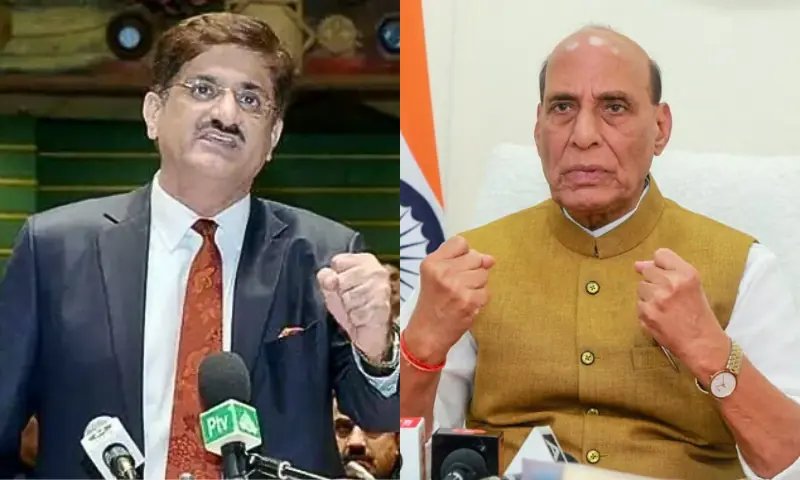
The Sindh Assembly on Thursday rejected the remarks of India’s Defence Minister Rajnath Singh regarding the province as “delusional” and said they were a deliberate attempt to distort history.

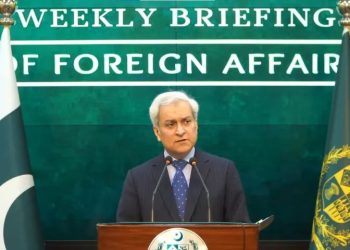
On Sunday, Singh said that “civilisationally, Sindh will always be a part of India”, and that “who knows, tomorrow Sindh may return to India again”. His words were strongly rebuked by the Foreign Office as “dangerously revisionist remarks” that revealed an expansionist Hindutva mindset.
The Sindh Assembly unanimously passed a resolution today, stating that the House “unequivocally condemns the Defence Minister of India’s statement as delusional, inflammatory, and a deliberate distortion of history, made in violation of diplomatic norms and international law”.
The resolution, moved by Excise Minister Mukesh Kumar Chawla, said the assembly asserted “with absolute clarity that Sindh is, and will forever remain, an inseparable and integral part” of Pakistan, and rejected any narrative, however absurd, which suggested otherwise.
The lawmakers rejected “with full force all revisionist, expansionist, and politically motivated claims emanating from India that attempt to rewrite the history of Sindh, Pakistan, or the movement for independence”.
It further condemned the extremist policies of Indian Prime Minister Narendra Modi’s government that “threaten regional peace, undermine civilisational heritage, weaponise water resources, and endanger the environmental security of millions”.
The resolution also called upon the government to “pursue decisive diplomatic, legal, and multilateral action to protect the Indus River, defend Pakistan’s rights under international treaties, and hold India accountable for violations of water, environmental, or humanitarian norms”.
New Delhi unilaterally held the Indus Waters Treaty in abeyance in April this year based on unsubstantiated claims regarding the Pahalgam attack, which were strongly refuted by Islamabad. A Sydney-based think-tank warned last month that India could manipulate river flows in the near term, presenting an “acute” danger for Pakistan.
In its resolution, the House expressed “firm solidarity with all communities, within Pakistan and across India, who respect the sanctity of the Indus, reject extremism and revisionism, and uphold the principles of justice, coexistence, and peace”.
The resolution presented by Chawla noted that Sindh was an “ancient civilisation with its own enduring identity, culture, a political consciousness, rooted in history far older and deeper than any modern state”.
It highlighted that the “people of Sindh, asserting their right to autonomy and dignity, chose in 1936 to separate from the Bombay Presidency, long before the creation of Pakistan, thereby demonstrating a clear and unequivocal will for self-governance”.
“Sindh was the first province to adopt the historic resolution in favour of the creation of Pakistan, playing a decisive and irreplaceable role in the establishment of the nation envisioned by Quaid-i-Azam Muhammad Ali Jinnah,” it stated.