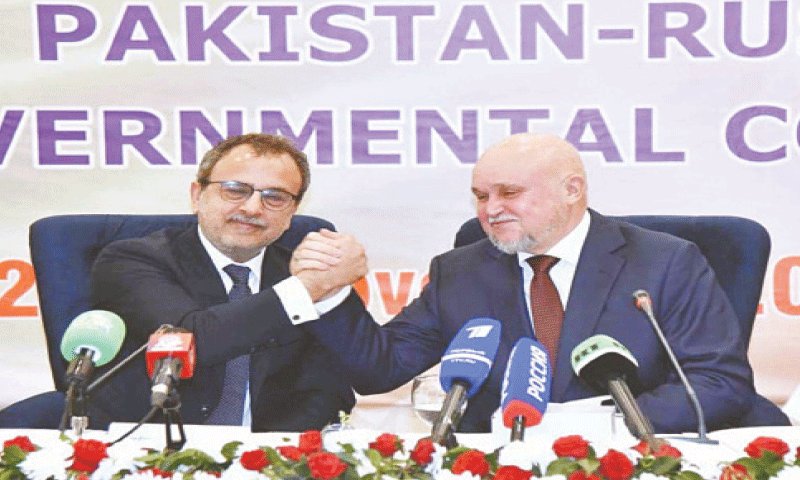
ISLAMABAD: Pakistan and Russia on Thursday reaffirmed their resolve to deepen bilateral cooperation in diversified trade, energy, business-to-business engagements and social sectors like health and education.

At the conclusion of the three-day 10th Pakistan-Russia Intergovernmental Commission (IGC) on Trade, Economic, Scientific and Technical Cooperation, the two sides also signed three memoranda of understanding (MoUs) for cooperation in quality standards, anti-monopoly regulation and the media sector.
The Nov 25-27 IGC was co-chaired by Energy Minister Awais Leghari and his Russian counterpart, Sergei Tsivilev.
“The two sides reaffirmed their commitment to a broad, forward-looking partnership that supports the socio-economic development of Pakistan and the Russian Federation and contributes to regional stability and connectivity,” an official statement said.
Both sides expressed satisfaction with the constructive discussions on enhancing bilateral trade, diversifying export portfolios and strengthening business-to-business engagement.
At 10th Intergovernmental Commission, both sides agree to boost cooperation in trade, business and education
They reiterated the importance of continued cooperation to facilitate trade fairs, exchanges between business communities and improved market access for key Pakistani products, including textiles, sports goods, IT services, engineering items and agricultural commodities.
The two delegations also acknowledged the significance of advancing the pilot cargo movement along agreed corridors and confirmed their intention to operationalise a pilot train, marking a tangible step towards improving regional logistics and connectivity.
Energy cooperation remained a central element of the dialogue, with both sides noting positive engagement in the oil and gas sectors, opportunities in LNG and LPG supply frameworks, and the importance of technical collaboration.
They also emphasised the potential for renewable energy, hydropower development, and water-related technologies, including hydrological monitoring and flood resilience.
In the industrial and technology sectors, discussions covered pharmaceutical cooperation, including insulin localisation, modernisation of the Pakistan Steel Mills’ metallurgical capacity, and possible ventures in heavy machinery, mining, and advanced manufacturing.
The two sides underscored the importance of scientific, academic and technological collaboration and reiterated plans to finalise intergovernmental agreements on higher education, the mutual recognition of degrees and scientific cooperation, alongside expanding scholarships, joint research and academic mobility in engineering, medical sciences, IT and space technology.
In this regard, both sides welcomed initiatives to establish Russian language centres in Islamabad and Karachi. A special ceremony was hosted by the Federal Directorate of Education (FDE) at the Islamabad Model College for Boys I-8, where a centre for Russian language learning is being launched.