• LHCBA petition wants ICAs ‘restored to their original forum’
• Says 27th Amendment ‘unlawful, undermining judiciary’
• Fears parliament can ‘abolish or replace forum for constitutional adjudication at will’ if permitted

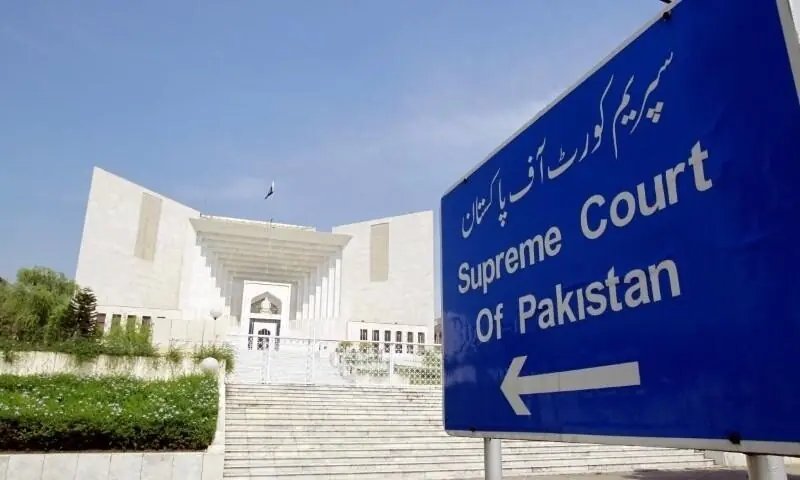
ISLAMABAD: The Lahore High Court Bar Association (LHCBA) on Thursday filed an application before the Federal Constitution Court (FCC), requesting that the pending intra-court appeals (ICAs) against the May 7, 2025 judgement on military trials of civilians be returned to the Supreme Court.
The application has been moved under Order 35, Rule 6 of the Supreme Court Rules, 2025, which the FCC has adopted for the time being until it frames its own rules.
On June 13, the LHCBA and the Lahore Bar Association filed ICAs before the SC, seeking to revisit and set aside the May 7, 2025 judgement on the military trials of civilians.
These appeals were filed through senior counsel Hamid Khan.
In addition, former chief justice of Pakistan (CJP) Jawwad S. Khawaja and senior lawyer Barrister Aitzaz Ahsan also filed similar ICAs, highlighting that if the May 7 verdict was not overturned, it would serve as a constant reminder of the judiciary ceding its space to the executive by accepting that the latter could act as judges to try civilians in criminal cases.
On May 7, a five-judge Constitutional Bench of the SC restored key provisions of the Pakistan Army Act (PAA) that allow for the trial of civilians in military courts.
The court ruled by a five-two majority in favour of overturning its earlier decision on Oct 23, 2023, in which a previous five-judge bench had held that the military trials of civilians involved in the May 9, 2023 acts of arson and attacks on military installations was illegal and unconstitutional.
Except for Justices Jamal Khan Mandokhail and Naeem Akhtar Afghan, who dissented from the majority verdict, the detailed reasoning of the majority judgement has yet to be issued.
‘Without lawful authority’
The fresh application pleaded that the pending appeals should be returned to their original forum — the SC — as both the purported transfer and the 27th Constitutional Amendment itself were without lawful authority, unconstitutional, and non-est.
The application contended that the 27th Amendment was in violation of the salient and essential features of the Constitution, stating that the 1973 Constitution defined the powers of the legislature, the executive, and the judiciary.
“While parliament possesses the power to amend the Constitution, it does not function as a constituent assembly and is subject to both express and implied limitations,” it added.
The application pointed out that the jurisprudence of the SC — most recently the authoritative 17-member judgement in the Rawalpindi District Bar Association case — had affirmed that parliament could not, through any amendment, alter or abrogate the salient or essential features of the Constitution, including the independence of the judiciary.
The application pleaded that both the 26th and 27th amendments impermissibly encroached upon judicial independence and restructured the constitutional architecture in a manner inconsistent with these unamendable features. Therefore, they constituted an invalid exercise of amendatory power.
It argued that a constitutional amendment, which undermined judicial independence while simultaneously divesting pre-existing constitutional courts of jurisdiction to examine its validity, violated fundamental constitutional principles.